Peter Brown PPNEAC, PS, Hon RBA, ROI (b. 1967)
Peter Brown NEAC is a painter of the city from direct observation, and served as President of the New English Art Club from 2018 to 2023. His standing in contemporary British art rests on the strictness of his method: he paints and draws only from the motif, en plein air or in interiors, without photographic reference.
Born in Reading in 1967, Brown took a Foundation course at Bath College of Higher Education (1986–87) and a BA (Hons) in Fine Art at Manchester Polytechnic (1987–90). He moved to Bath in 1994, where he made his name with charcoal drawings of the city, and became a full-time painter in 1995. In 1998 he met Peter Kuhfeld there, was introduced to Bill Patterson of W.H. Patterson Fine Arts, and was elected to the NEAC. His first solo exhibition, at the Victoria Art Gallery, Bath, followed in 2000. In 2004 he showed in Bath with Richard Pikesley and began exhibiting with Messum's, Cork Street, and in 2006 became the first Artist in Residence at the Savoy Hotel, London.
The habit that earned him the nickname "Pete the Street" (painting outdoors in all weathers, often in conversation with passers-by) places him in a particular line within the Club. Its early character was shaped by two exact contemporaries: Philip Wilson Steer (1860–1942), whose Impressionism grew from painting out of doors, and Walter Sickert (1860–1942), who, following Degas, built his pictures in the studio from drawings made on the spot and, later, increasingly from photographs. Brown pushes that direct outdoor principle further than Steer
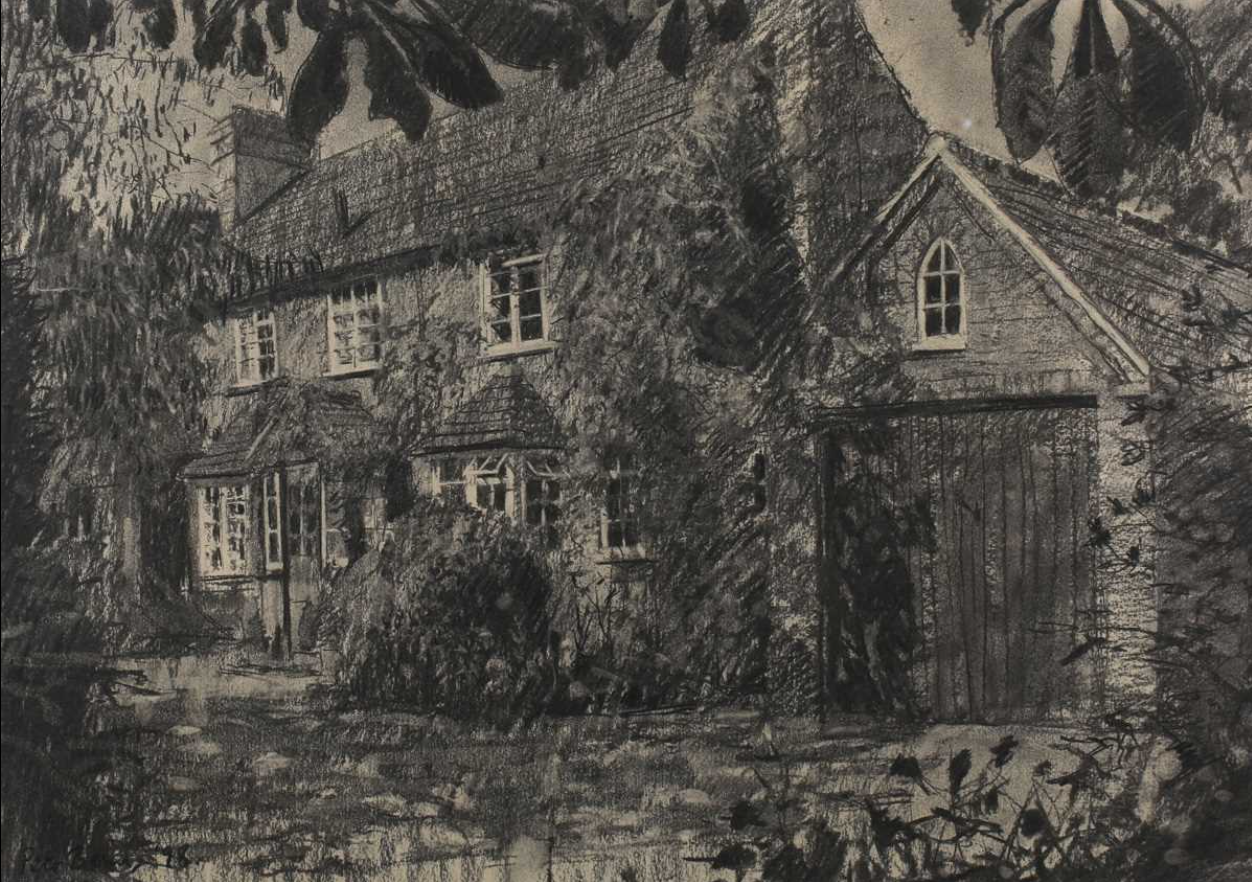
Peter Brown PPNEAC, Country Cottage (1998), Charcoal on paper (56 × 39 cm), framed and glazed (75.5 × 60cm). Signed.
himself often did—painting on the spot at scales from 15 × 20 cm right up to 150 × 200 cm—and more strictly than NEAC contemporaries such as Kuhfeld and Tom Coates (1941–2023), who have regularly developed larger studio compositions from preparatory studies. Without a photograph to consult, he cannot defer decisions. A camera records detail without selection and holds a narrower tonal range than the eye, so that shadows block up and lights burn out; working on the spot, he must judge which few tonal relationships carry the motif and commit to one condition of light before it changes. His streets are accordingly built from broad tonal masses, with weather carried by value as much as colour. Buildings, which hold still for the length of a sitting, are given measured architectural weight, while figures and traffic, which do not, are stated in a few abbreviated touches. That tension between the fixed and the passing, recorded over the duration of looking rather than in a fraction of a second, is as much the subject of these pictures as any particular view.
Charcoal remains the foundation. It is a medium of mass rather than outline, in which forms are built and corrected through tone, and the habit of seeing in shapes of value that it trains remains legible in his oil paintings. His draughtsmanship has earned both the Hunting Art Prize for Drawing (2005) and the Prince of Wales Award for Portrait Drawing (2008), which sit alongside the ROI's Le Clerc Fowle Medal (2013), the NEAC's Michael Harding Award (2023) and six NEAC Critics' Choice awards. The same scrutiny is turned indoors, on domestic interiors and portraits of his family. Alongside work painted in Varanasi, Paris, Barcelona and Toronto, his monographs on Bath, London, Bristol (2025) and Glasgow (2026) form a sustained survey of the British city painted from life.
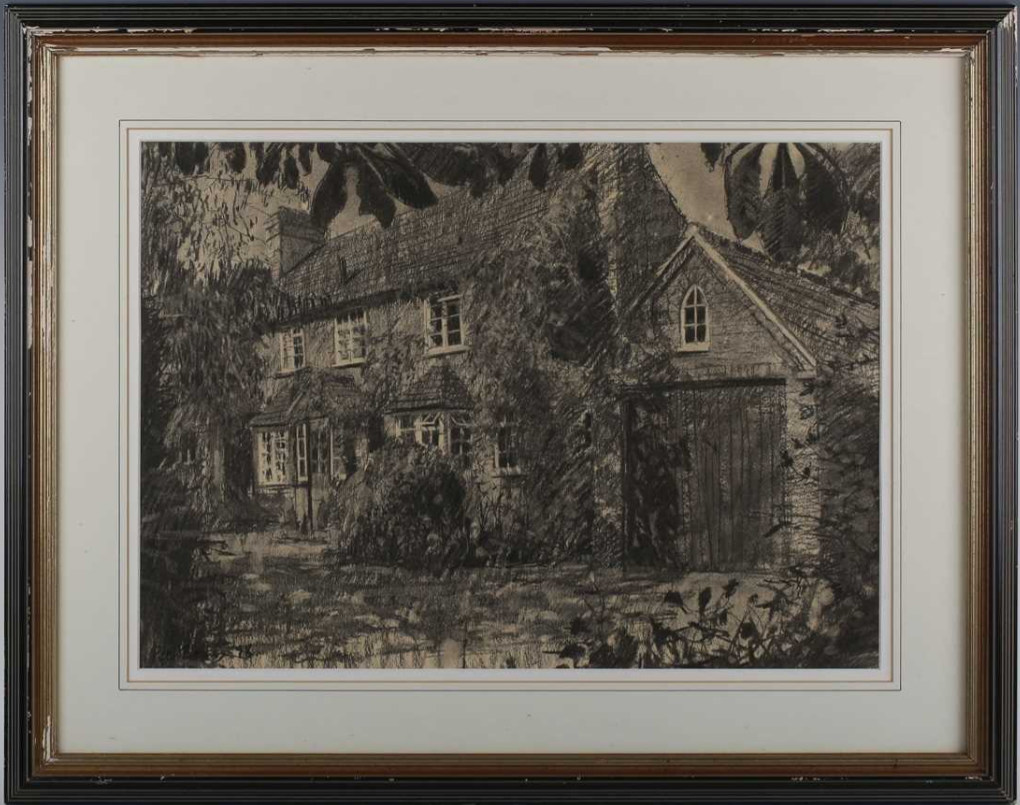
Peter Brown PPNEAC, Country Cottage (1998), Charcoal on paper (56 × 39 cm), framed and glazed (75.5 × 60cm). Signed.
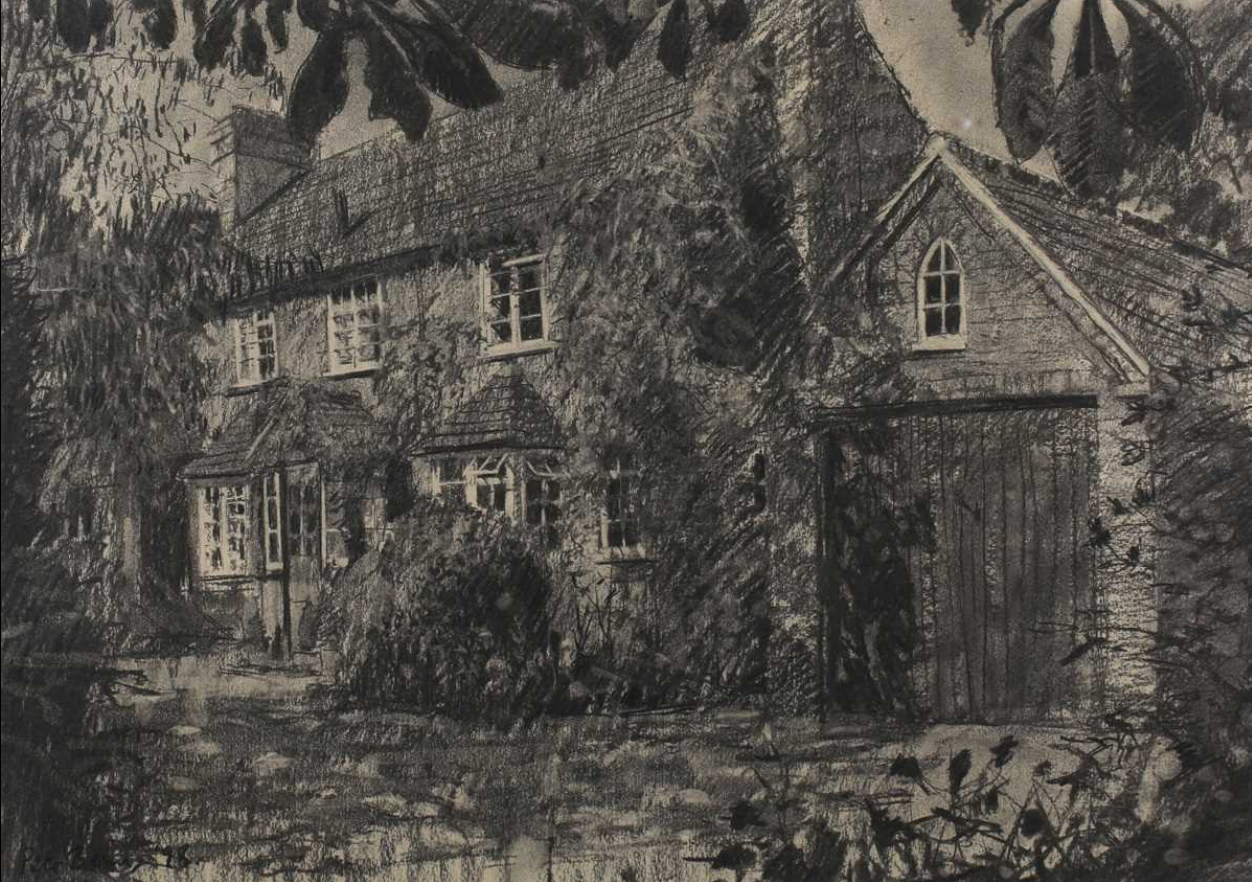
Peter Brown PPNEAC, Country Cottage (1998), detail.